
Beauty / Wellness / Skin / Hair


Beauty / Wellness / Skin / Hair
I Spent $4,847 on Skincare Last Year. The Thing That Actually Worked Cost Me $59.
A 32-year-old's three-year journey through dermatologists, $80 moisturizers, and prescription topicals — and the surprising root cause she'd never heard anyone talk about.
By Sarah Chen | Updated April 2026 | 7 min read
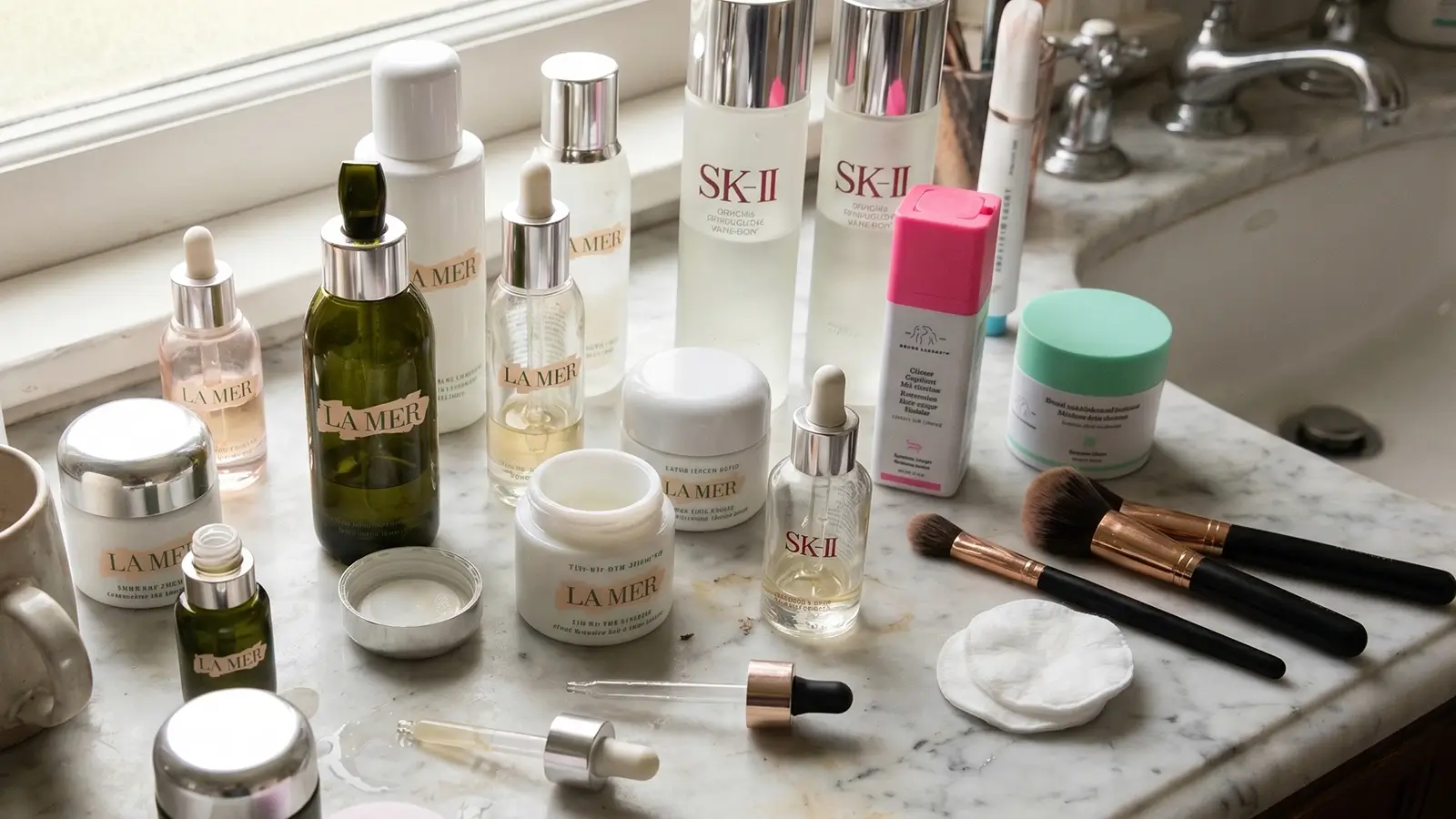
I want to start this with a confession, because I think a lot of you reading this are going to recognize yourselves in it.
Last year, I added up everything I'd spent on my skin.
Serums. Barrier creams. Three different cleansers. Two prescription topicals. Four dermatologist visits. And one painfully expensive in-office treatment.
The total was $4,847.
I'm not a beauty influencer. I'm not wealthy. I'm a 32-year-old marketing manager who just wanted her face to stop hurting in the morning.
After three years of throwing money at the problem, my skin was arguably worse than when I started.
Then, in November, a friend asked me a single question that changed everything. Within 30 days of acting on her advice, my skin was unrecognizable — and I'd spent a grand total of $59.
No new serums. No new dermatologist. No prescription. No skincare routine change at all.
I'm writing this because I genuinely wish someone had told me earlier. And once I tell you what was actually wrong, I think you're going to be as angry as I was that no one mentioned it sooner.
Here's what happened.
The Problem I Couldn't Solve
It started slowly, the way these things do.
I was 29 when I first noticed my skin felt tight every morning. Just tight — not painful, not visibly bad. I assumed I needed a richer moisturizer. So I bought one.
By 30, the tightness had progressed to actual discomfort. Red patches started appearing on my cheeks, coming and going without any pattern I could identify. I switched to a "barrier repair" serum that cost $84 a bottle.
By 31, I had four different things going on simultaneously:
Tight, dry skin every single morning, no matter what I put on it
Red, reactive patches that flared up unpredictably
Flaky areas around my nose that no exfoliant could smooth out
Breakouts on my jawline that didn't fit any "hormonal" pattern my dermatologist could identify
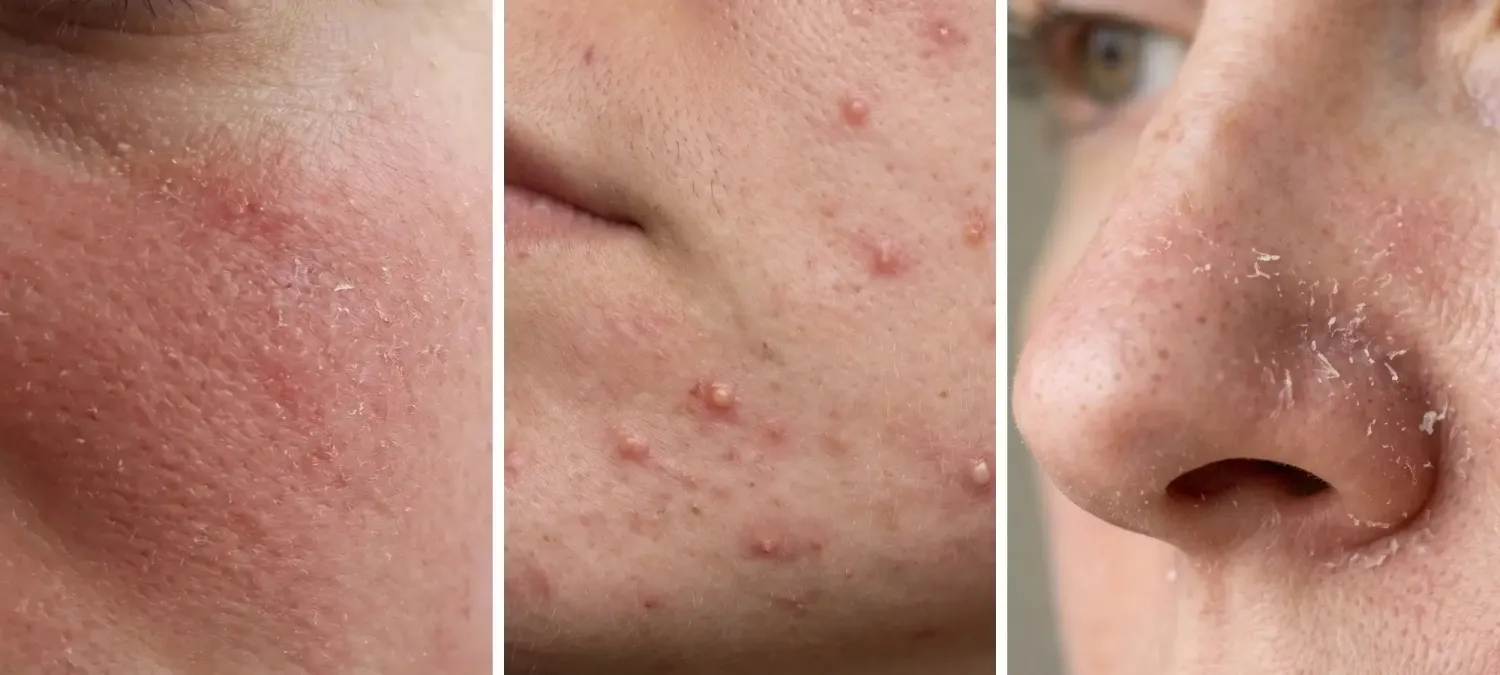
If you're reading this and any of those sound familiar — especially if you've already invested money in fixing them and nothing has worked — I need you to keep reading.
Because what I'm about to tell you is the thing my dermatologist never mentioned. The thing not a single skincare ad will ever say. And the thing that turned out to be the actual root cause for me.
I tried, in this order:
Three different "barrier repair" serums ($240)
A $94 ceramide moisturizer
Switching to a "gentle" cleanser ($38)
Cutting out actives entirely for 8 weeks
Going to a dermatologist (4 visits, $480 in copays)
Two rounds of prescription tretinoin (which made it worse)
Prescription topical anti-inflammatories ($120)
An LED mask ($299)
An in-office facial treatment ($380)
Eliminating dairy for 90 days
You see where this is going. The total kept climbing. My skin kept failing.
By October, I was genuinely starting to wonder if something was wrong with me on a deeper level — like maybe I'd just be this person, with this skin, forever.
That's when Maya asked me her question.
The Question That Changed Everything
In November, I was venting to my friend Maya about my skin.
Maya is one of those annoyingly low-maintenance people whose skin just works. She uses, like, three products. Her face is permanently glowing. I've hated her for years in the most loving way possible.
Halfway through my rant about my latest dermatologist visit, she said something that genuinely stopped me mid-sentence:
"Have you ever actually tested your shower water?"
I stared at her.
"My… what?"
She told me that two years ago, she'd moved into a new apartment and her skin had gone haywire. After months of trying to fix it with products, her landlord casually mentioned the building had "hard water." She'd never thought about water before.
So she'd bought a filtered showerhead — a brand called Dewvara that she'd found through a dermatologist friend's recommendation.
Her skin cleared up in about three weeks.
She'd been using it every day for almost two years since, and the problem had never come back.
She actually walked me into her bathroom to show me hers. It looked like a normal showerhead, just chunkier in the handle where the filter sits. She handed it to me and said:
"Just buy one. Seriously. It's $59. You've spent more than that on a single moisturizer."
She wasn't wrong about that.
I went home that night and did what I always do before any purchase that matters — I started reading everything I could find on hard water and skin.
What I found genuinely made me angry — because it was clearly the answer, and no one in the entire skincare industry had ever mentioned it to me.
Not a single dermatologist. Not a single product page. Not a single beauty editor.
Here's what I learned.
What's Actually In Your Shower Water (And Why No One Talks About It)
According to data from the U.S. Geological Survey, approximately 85% of homes in the United States receive hard water.
"Hard" doesn't mean dangerous to drink — it means the water contains high levels of minerals and chemicals that, while safe for consumption, are not friendly to your skin.
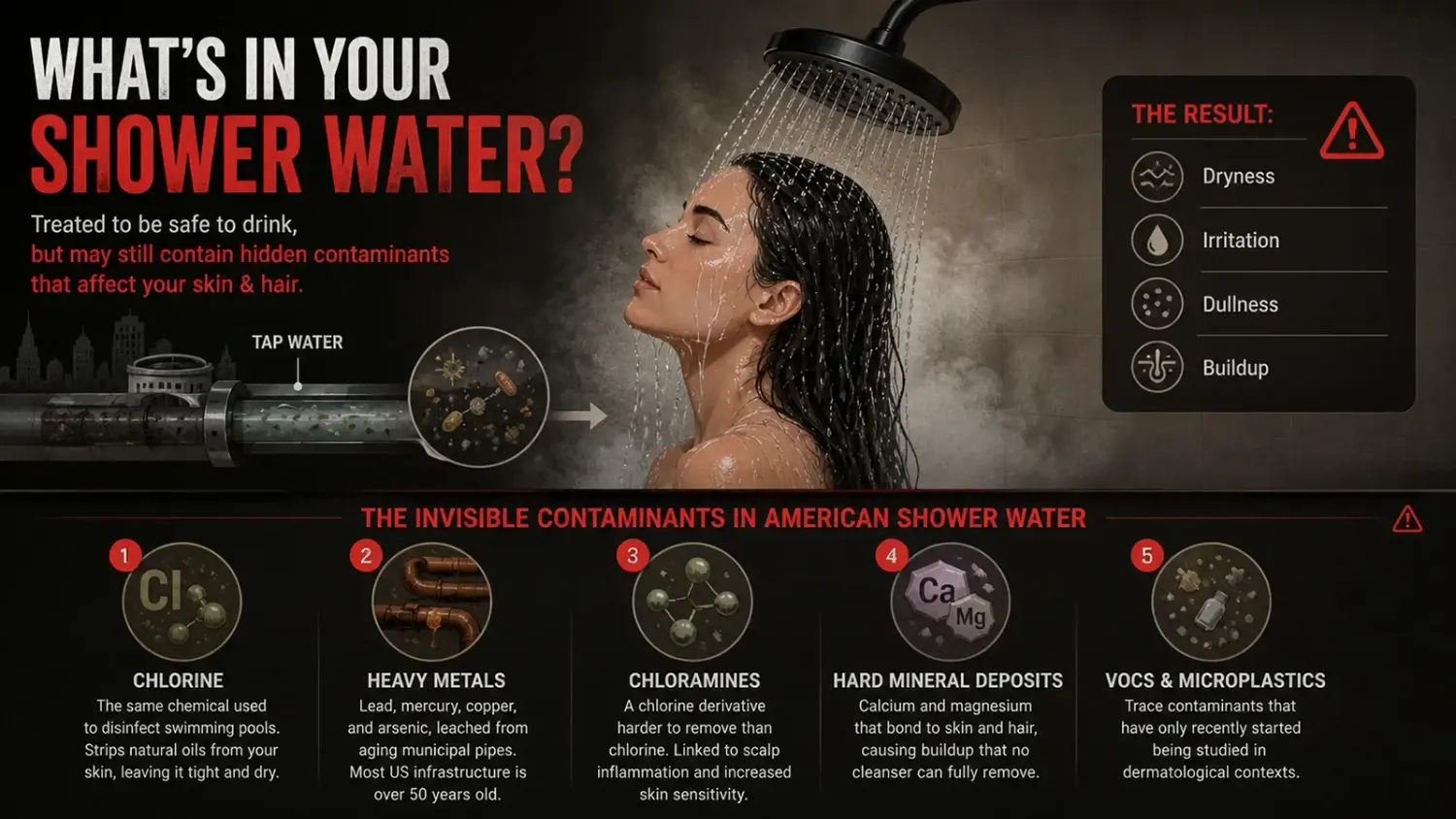
Specifically, the average American shower water contains:
Chlorine. The same chemical used to disinfect swimming pools. It's added to municipal water as a disinfectant. It's also extremely effective at stripping the natural oils from your skin barrier — which is exactly why your face feels tight after a shower.
Heavy metals. Lead, mercury, copper, and arsenic, leached from aging municipal pipes. Most US water infrastructure is over 50 years old. These metals don't get filtered out at the treatment plant.
Chloramines. A chlorine derivative that's actually harder to remove than chlorine itself. For some people with sensitive skin or scalp, chloramines may contribute to dryness or irritation.
Hard mineral deposits. Calcium and magnesium that physically bond to your skin and hair, creating buildup that no cleanser can fully remove.
VOCs and microplastics. Trace contaminants that have only recently started being studied in dermatological contexts.
A 2018 study published in the Journal of Investigative Dermatology found that infants exposed to hard water in their first three months of life had an 87% increased risk of developing eczema.
Other research has linked hard water exposure to worsened atopic dermatitis, increased skin sensitivity, and disruption of the skin's natural microbiome.
In plain English: the water you're using to wash your face every single morning may be quietly undoing every product you've ever paid for.
I sat at my kitchen table that night and did a small calculation.
I shower for 8 minutes a day.
Over three years, that's 145 hours my face had been in direct, sustained contact with chlorinated water.
For comparison, my $84 barrier repair serum was on my face for maybe 15 minutes a day, max.
It was suddenly very obvious which side was going to win that fight.
The $24 Mistake I Made First
I should have just bought Dewvara that night. Maya had told me what to get, she'd shown me hers, and the science backed up everything she'd said.
But I'm a chronic over-researcher. Three years of skincare disappointment had made me skeptical of any single recommendation, even from a friend I trust.
So instead of just listening to her, I spent the next morning doing what I always do — looking for a cheaper alternative.
There are basically three options for filtering shower water:
Option 1: Whole-house water softener.
Cost: $1,500–4,000 plus installation. Requires a plumber. Not an option for renters. Hard pass.
Option 2: Cheap shower filter (single-stage carbon).
Cost: $20–40 on Amazon. Screws onto your existing showerhead. Tons of 4-star reviews. Tempting because it was less than half the price of Dewvara.
Option 3: A multi-stage filtered showerhead like Dewvara.
Cost: around $59. Replaces your entire showerhead. Uses multiple filtration layers.
I talked myself into Option 2. Carbon is carbon, I figured. Why pay more for the same thing?
So I bought a $24 single-stage filter from Amazon — the one with thousands of 4-star reviews — telling myself I'd test the concept first before committing to the more expensive option Maya had recommended.
I installed it. I waited two weeks.
Honestly? I noticed something. My skin felt slightly less tight in the morning.
But it was nothing like what Maya had described. The redness was unchanged. The breakouts were unchanged.
It felt like maybe a 10% improvement, when she'd been describing something closer to a 90% transformation.
I went back and read more carefully. The thing that kept coming up — both on Reddit and in the technical specs — was the filtration depth.
The cheap filter I'd bought had a single-stage carbon layer. Dewvara uses 18 stages, with three different filtration materials stacked together (activated carbon, PP cotton, and mineral stones).
Multiple Reddit threads on r/SkincareAddiction said the same thing: the cheap single-stage filters do something, but they don't do enough. The multi-stage ones do something visible.
So I gave up on saving $35 and finally ordered the one Maya had told me to buy from the start.
It arrived three days later.
The First Shower
I want to describe the first shower honestly, because I've read enough exaggerated product reviews to be allergic to dramatic language.
It didn't feel like a religious experience. It didn't feel like a spa.
It felt like… softer water.
Like the difference between washing your hands at a hotel versus at a gas station rest stop. Subtle, but real.
The first thing I noticed wasn't on my skin — it was on my hair. My hair, which is normally squeaky-clean and slightly stiff after washing, felt smoother. Like I'd used conditioner, even though I hadn't yet.
The second thing I noticed was about ten minutes after I got out of the shower.
I forgot to put on moisturizer.
I want you to understand how unhinged that is.
I have not forgotten moisturizer in approximately seven years. Putting on moisturizer immediately after getting out of the shower is a reflex I have, like blinking.
The reason I didn't do it that night is because I wasn't feeling the tightness that normally prompts me to do it.
I sat on my bed for fifteen minutes before I realized.
I won't pretend that was the moment everything changed. It was just one shower.
But it was the first time in three years that something about my skin felt different in a way I couldn't immediately explain.
I went to bed thinking maybe I was imagining it.
I wasn't.
The 30-Day Timeline
I kept notes, because I'm that kind of person. Here's what actually happened, week by week:
WEEK 1
The morning tightness was noticeably reduced — not gone, but reduced. I started cutting my moisturizer application in half, because my skin felt less desperate for it. No new breakouts that week, which was unusual.
WEEK 2
The red patches on my cheeks started fading. I genuinely cannot explain this any other way: I wasn't doing anything different with my skincare. Same cleanser. Same serum. Same moisturizer. The biggest change I had made was switching the water I was showering with.
WEEK 3
My existing breakouts on my jawline were healing faster than usual, and no new ones were appearing. My skin texture started looking smoother in photos.
WEEK 4
I went a full day without makeup for the first time since 2022. My skin looked, for lack of a better word, calm. The flakiness around my nose was gone. The redness looked noticeably calmer in photos. The tightness I used to feel every morning was barely noticeable.
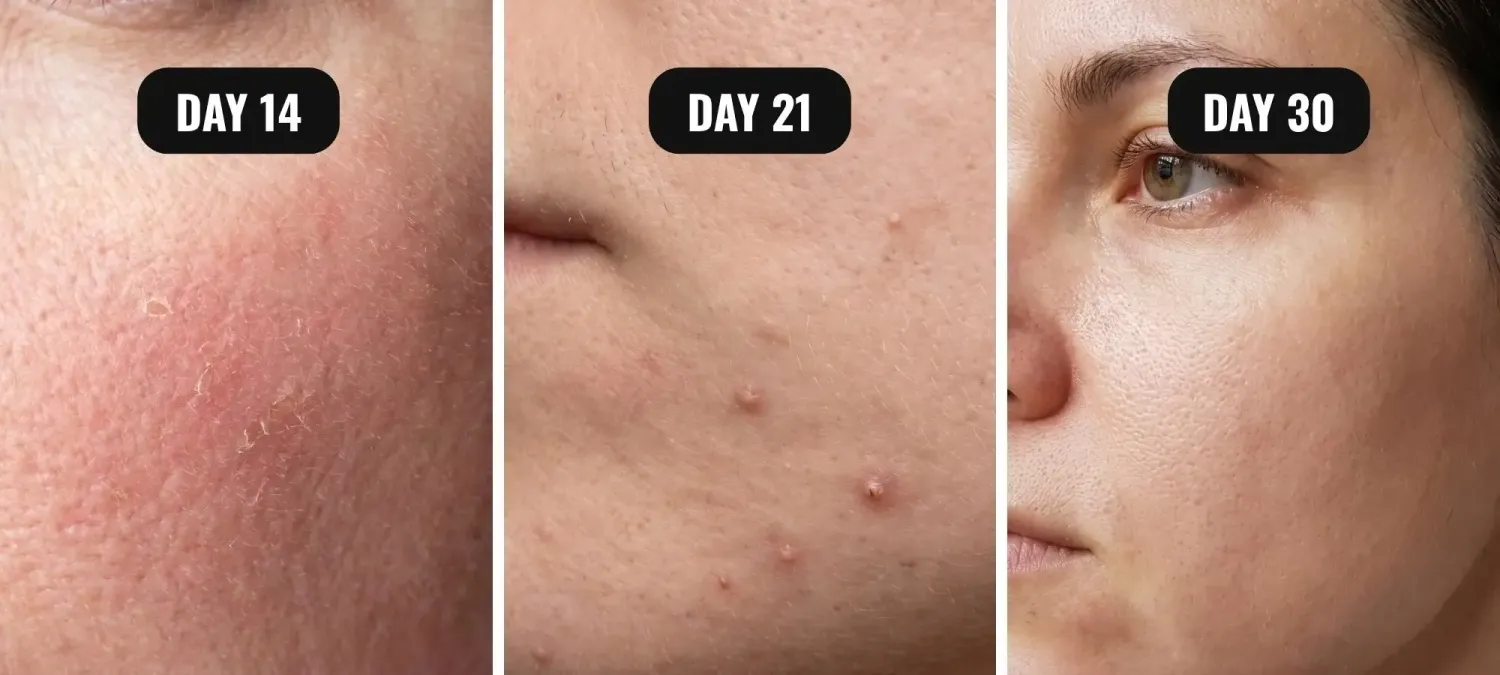
I took before-and-after photos using the same lighting, same time of day, no filter. The difference was clear enough that I texted them to Maya, who responded with three exclamation points and the words "I told you."
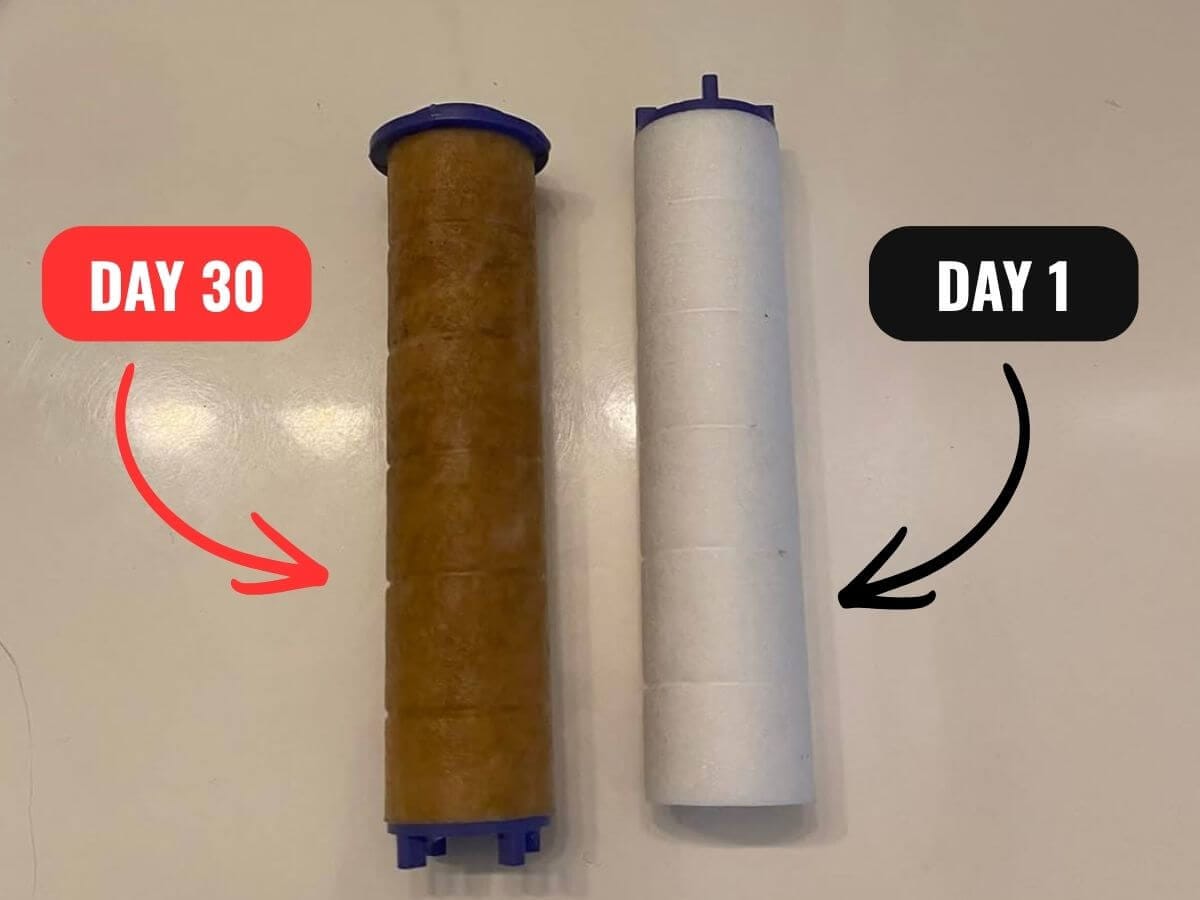
I also did something a little gross — I checked the filter cartridge after 30 days of use.
It came out of the showerhead black and yellow, completely discolored from what it had captured.
That stuff had been hitting my skin every single shower for years before I had any idea.
I kept the filter on my bathroom counter for a few days as a reminder. My partner thought it was disgusting. He wasn't wrong.
What I Asked My Dermatologist
I want to be careful here, because I'm not a doctor and I don't want to overstate anything.
When I went in for a follow-up in March, my dermatologist (who knows my skin history extensively) commented unprompted that my skin looked "significantly improved." She asked what I'd changed.
I told her: nothing in my routine. Just the water.
She wasn't surprised. She told me that water quality is something she's been thinking about more and more in patient cases — particularly with patients who have persistent dryness, sensitivity, and irritation skin conditions that don't respond to standard interventions.
She said, and I'll never forget this:
"A lot of what I see in my practice could probably be solved by changing the variables we don't think about — and water is the biggest one we don't think about."
This isn't a clinical endorsement. It's one dermatologist's observation. But it lined up with what I'd already experienced — and with what Maya's dermatologist friend had apparently told her two years earlier.
I also looked into Dewvara's own dermatologist endorsements after the fact. Their site features Dr. Evelyn Reed, a board-certified dermatologist in Beverly Hills, who has reportedly discussed shower water quality with many of her patients. Her quote on their site:
"As a dermatologist, I see patients every week who blame their skincare routine — when the real culprit is their shower water. For people dealing with dryness or irritation, improving shower water quality is one variable worth considering."
Make of that what you will. I take all branded testimonials with a grain of salt — but the underlying claim (that hard water damages the skin barrier) is well-established in the dermatological literature, regardless of which company is selling the solution.
How It Actually Works
I'm a "show me the spec sheet" kind of person, so I went deep on the technical details after I'd already seen results.
Here's what's inside the Dewvara Glow Shower, in plain language:
Layer 1: Activated Carbon
This is the workhorse. Activated carbon is what most water filters use because it's been scientifically validated to remove up to 99% of chlorine and a wide range of volatile organic compounds (VOCs). It's the single most important layer for anyone whose skin reacts to chlorine.
Layer 2: PP Cotton (Polypropylene)
This traps physical particles — rust, sediment, microplastics — down to about 5 microns in size. For context, a human hair is around 100 microns. So this catches things 20 times finer than a hair.
Layer 3: Mineral Stone
This is the layer that surprised me most. Instead of just removing things, it adds trace minerals back into the water (the beneficial ones, not the skin-stripping ones). The result is water that feels noticeably softer.
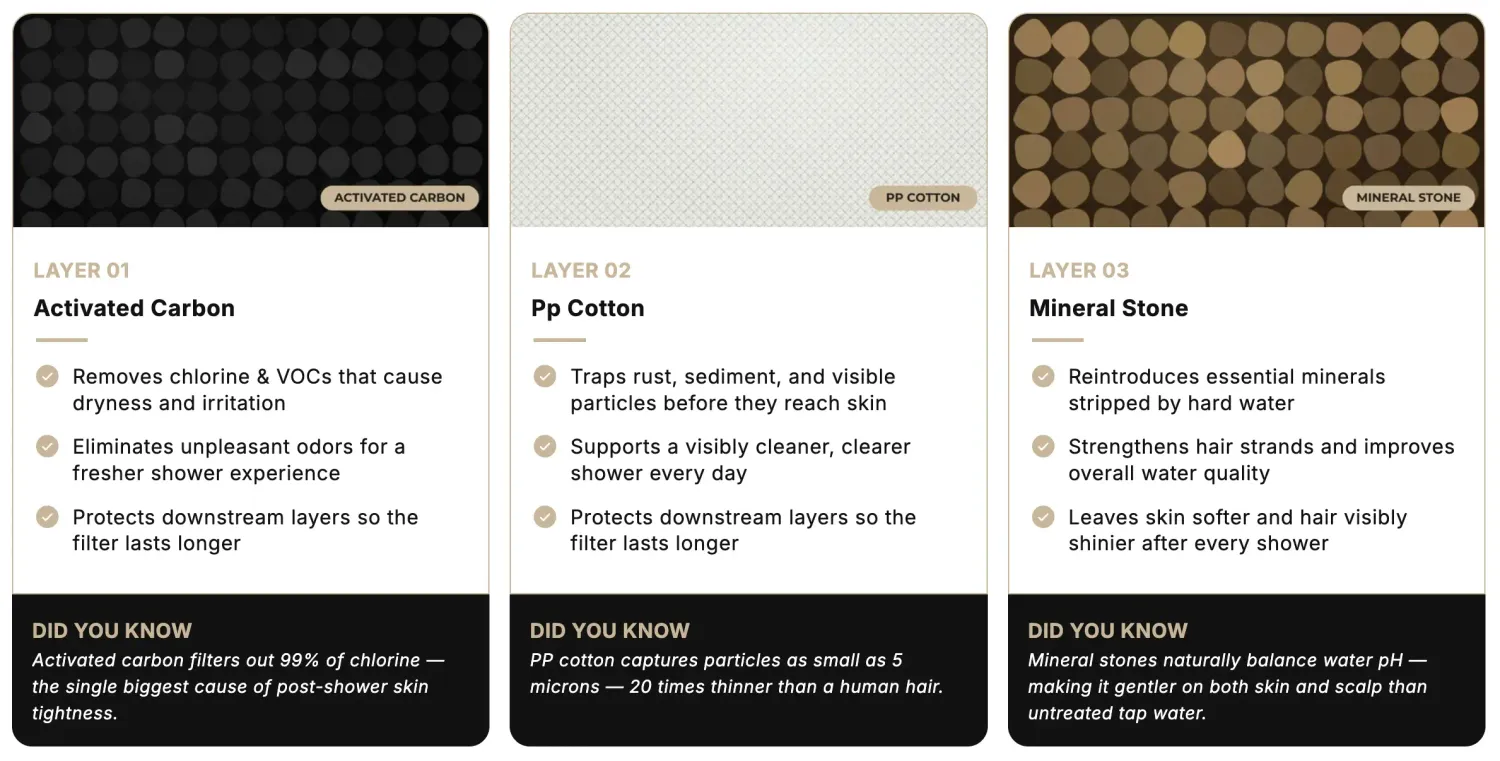
These three layers are repeated and stacked across 18 total stages — which is the actual difference from the single-stage carbon filter I'd tried first.
(That cheap filter had one carbon layer. That's why the difference was marginal.)
The Details That Made It Easy To Use
The whole assembly screws onto your existing shower arm in about four minutes. No tools. No plumber. If you can change a lightbulb, you can install this.
(I am notoriously bad at home repairs and I had no problems.)
It also has four pressure modes — Rainfall, Mist, Mixed, and Jet — and the pressure boost is genuinely noticeable, especially if you live in an apartment with weak water pressure like I do.
The replacement filters last about 30 days each. I subscribed to the auto-replacement plan ($12.90 for the first refill, then $19.99/month after) so I don't have to think about it.
What I'd Tell Someone On The Fence
If you've read this far, you're probably someone whose skin has been bothering them for a while, and you're trying to decide whether this is worth a try.
Here's my honest take, with no pressure:
✅ TRY IT IF
You've already invested significantly in skincare and aren't seeing results
Your skin feels tight, reactive, or irritated specifically in the morning or after showering
You've tried barrier repair products with limited success
You live in an area you suspect has hard water (most of the US does)
You're willing to commit to 30 days to see if it actually works for you
❌ SKIP IT IF
Your skin is already perfectly fine and you have no symptoms
You're not willing to install a new showerhead
You already have whole-house water filtration
You're looking for an instant overnight fix (this took me 3–4 weeks to see clear results)
The 30-day money-back guarantee made it feel like a low-risk experiment. I figured: if it didn't work, I'd return it. The guarantee is real — I checked their refund policy carefully before ordering.
Also: skip the $24 Amazon filter I tried first. I genuinely wish I'd just listened to Maya from the start and saved myself two weeks of testing the wrong thing. The 18-stage filtration is the actual reason this works — not just having "a filter."
For me, it was the single best $59 I've ever spent on my skin. Possibly the single best thing I've spent any money on in 2026, full stop.
I'm not exaggerating when I say I wish I'd found this three years and $4,800 ago.
Where to Get It
Dewvara is currently running a Buy 1 Get 1 Free promotion on their site, which means you can get two showerheads for the price of one.
I bought one for my main bathroom and gave the second to my mom (who, predictably, is now obsessed with it).
I don’t know how long this offer will stay live, but when I checked, Dewvara was still running a Buy 1 Get 1 Free promotion.

If your skin has been bothering you for months, this is at least worth looking at.
If you're on the fence, here's what I'd say: with a 30-day money-back guarantee, the only thing you're risking is the four minutes it takes to install. If your skin doesn't feel different in 30 days, you get every penny back.
That's a much better deal than another $84 serum that might not work either.
Sources & Further Reading
U.S. Geological Survey — Water Hardness and Hard Water Data
Journal of Investigative Dermatology — Hard Water Exposure and Skin Barrier Research
American Academy of Dermatology — Dry Skin and Irritation Guidance
Copyright © 2026 Daily Glow Journey. All Rights Reserved.
This site is not a part of the Facebook website or Facebook Inc. Additionally, this site is NOT endorsed by Facebook in any way. FACEBOOK is a trademark of FACEBOOK, Inc.
Disclosure: This article contains affiliate links. If you purchase through links on this page, Daily Glow Journey may earn a commission at no additional cost to you. Individual results may vary.
Disclaimer: This content is for informational purposes only and is not medical advice. Statements on this page have not been evaluated by the FDA. This product is not intended to diagnose, treat, cure, or prevent any disease.